Safe · Comfortable · Reliable
Safe · Comfortable · Reliable
Safe · Comfortable · Reliable
THE VISION — ONE VAN IS THE START, NOT THE CEILING
Broome's MMM 6 (Remote) classification unlocks NDIS remote zone pricing. The operator (Damian Smith) drives the vehicle personally — no driver wages in Year 1, maximising net income. Revenue is diversified across eight streams. Figures assume 48 working weeks, 6 days/week operation.
| Revenue streams — weekly | |
|---|---|
| NDIS town runs (25–30 trips × $35–45 flat zone) | $1,000–1,200 |
| Heliport crew — INPEX, Shell, Woodside (4 runs × $85–120) | $340–480 |
| Airport shuttle — 14-seat HiAce (2–3 runs/day, $15–18/pp seasonal avg) | $400–600 |
| Hospital transfers — Broome Hospital WACHS (5 runs × $40–50) | $200–250 |
| Hotel & resort drops (3–4 runs × $55–65) | $180–250 |
| PTSS 75% fare subsidy — eligible wheelchair trips (5–6 runs) | $200–240 |
| Croc Park day trips — WAV tour shuttle (1–2/wk, 14 seats × $45/pp) | $200–315 |
| Private airport transfers — door-to-door (3–4 runs × $55–85) | $195–300 |
| Total weekly revenue | $2,715–3,635 |
| Annual revenue (48 working weeks) | $130,320–174,480 |
| Operating costs — annual (owner-operated) | |
|---|---|
| Vehicle rent-to-own payment (incl. insurance, registration & servicing) | $14,560 |
| Fuel (est. 600km/wk × $2.30/L ÷ 8.6L/100km) | $8,320 |
| Phone, data, booking system, accounting software | $2,400 |
| ODBS/PTV/PTD authorisation fees | Waived (grant recipient) or ~$500 |
| TLIC0026 WAV driver competency training | $800 |
| Branding, livery and signage | $2,500 |
| Consumables (cleaning, PPE, admin) | $1,200 |
| Total annual operating costs | $29,780 |
| Year 1 summary | |
|---|---|
| Annual revenue (base case, $151K mid-point) | $151,000 |
| Annual operating costs | $29,780 |
| Net income (before tax, owner-operated) | $121,220 |
| Profit margin | 80% |
| Sensitivity analysis | |||
|---|---|---|---|
| Scenario | Revenue | Costs | Net |
| Conservative (50% utilisation) | $96,000 | $28,000 | $68,000 |
| Base case (65% utilisation) | $151,000 | $29,780 | $121,220 |
| Strong demand (80% utilisation) | $186,000 | $30,500 | $155,500 |
| Full capacity | $210,000 | $30,500 | $179,500 |
The vehicle payment of $280/week is covered by two heliport runs or seven NDIS town trips — everything above that is operating profit. Even at 50% utilisation (the conservative worst case), net income of $68,000 is more than 4.6× the annual vehicle payment. The business is debt-free, launched with private capital, and requires no grant funding to be viable. Cashflow is positive from Month 1.
Malcolm Douglas Croc Park is Broome's #1 family attraction. Current tour operators charge $75–100/pp and use standard buses — zero wheelchair-accessible tour vehicles exist. Wheely Good Rides offers the only WAV tour shuttle at $45/pp (14 seats). One full tour = $630. At just 2 tours per week at 50% occupancy, that's an extra $16,380/year from a market segment with literally zero competition. Tourists with mobility needs currently cannot visit the Croc Park at all — this service opens the door.
The second WAV targets a completely different market — mass passenger shuttles timed to every scheduled airline arrival and departure, plus twice-daily Croc Park day trips. This vehicle requires a hired casual driver (30hrs/wk, above-award rate with on-costs). All figures conservatively modelled at 50–60% occupancy. Dry season: April–October (30 weeks). Wet season: November–March (22 weeks).
| Airport Shuttle — 14 seats × $15/pp | |
|---|---|
| Dry season — 6 runs/day, 55% occupancy (8 pax avg) | |
| Daily: 6 × $120 = $720 · Weekly (6 days) | $4,320 |
| Season total (30 weeks) | $129,600 |
| Wet season — 3 runs/day, 25% occupancy (4 pax avg) | |
| Daily: 3 × $60 = $180 · Weekly (6 days) | $1,080 |
| Season total (22 weeks) | $23,760 |
| Annual airport shuttle revenue | $153,360 |
| Croc Park Day Trips — 14 seats × $45/pp | |
|---|---|
| Dry season — 2 tours/day, 45% occupancy (6 pax avg) | |
| Daily: 2 × $270 = $540 · Weekly (6 days) | $3,240 |
| Season total (30 weeks) | $97,200 |
| Wet season — 1 tour/day, 25% occupancy (4 pax avg) | |
| Daily: 1 × $180 = $180 · Weekly (6 days) | $1,080 |
| Season total (22 weeks) | $23,760 |
| Annual Croc Park revenue | $120,960 |
| Second vehicle — annual P&L | |
|---|---|
| Revenue | |
| Airport shuttle | $153,360 |
| Croc Park day trips | $120,960 |
| Wet season NDIS overflow / heliport fill-in | $15,000 |
| Total revenue | $289,320 |
| Costs | |
| Driver — casual 30hrs/wk, $45/hr + super + workers comp | $73,872 |
| Vehicle rent-to-own (incl. insurance, rego & servicing) | $14,560 |
| Fuel (shorter runs, airport loop + Croc Park) | $5,000 |
| Airport ParkCharge swipe card (~$5/entry × 6 daily) | $9,360 |
| Vehicle consumables, cleaning, compliance | $5,000 |
| Total costs | $107,792 |
| Second vehicle net income | $181,528 |
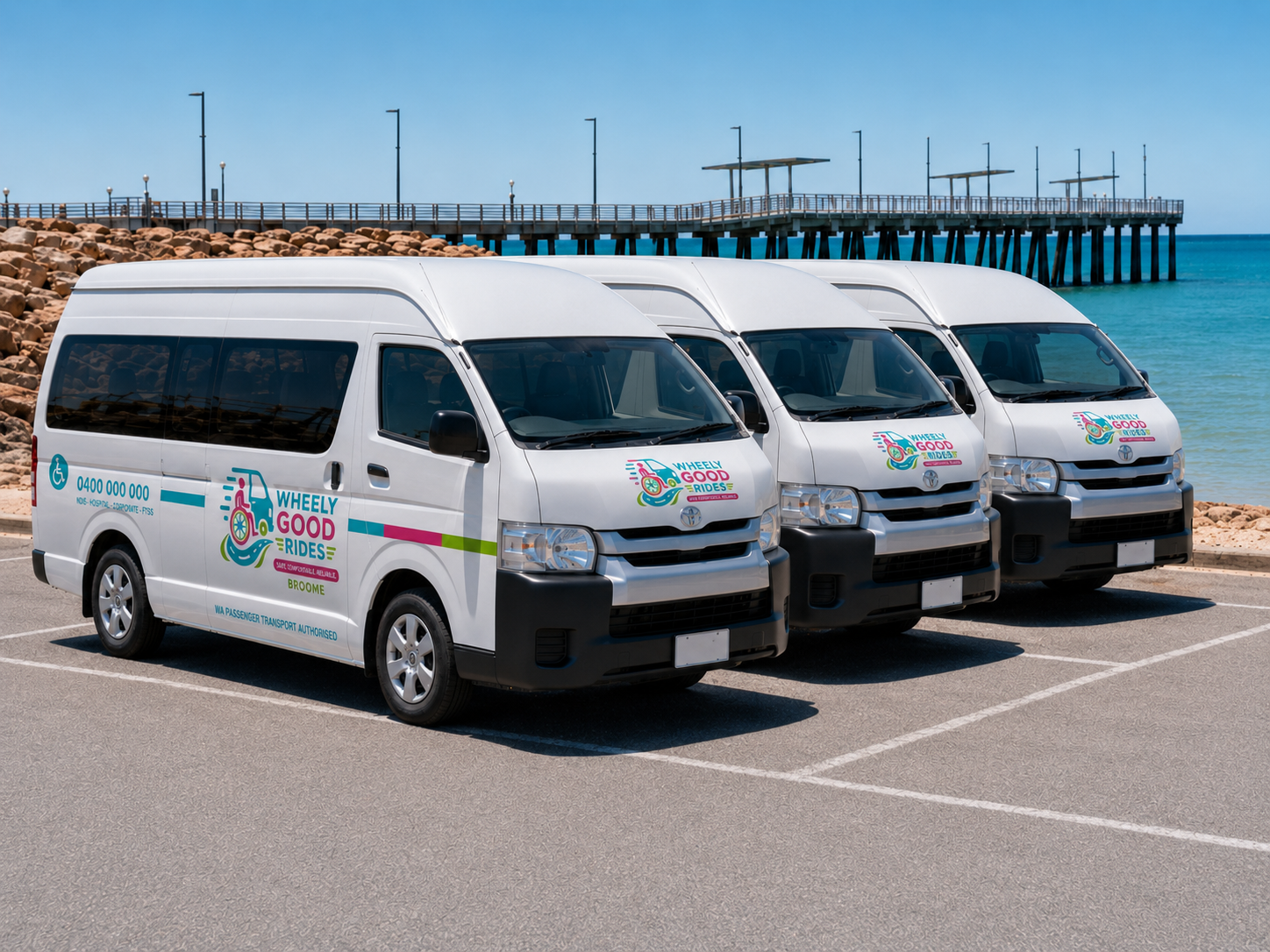
Broome Airport handles 6–10 commercial flights daily in dry season across Qantas (2×), Virgin Australia (1–2×), Airnorth, Skippers Aviation, Nexus Airlines, Aviair, and seasonal Jetstar services. The shuttle is timed to every major arrival and departure, not just peak hours. Pre-booked via the airport landing page. At $15/pp it undercuts Broome Transit's $20/pp shuttle by 25% — and offers wheelchair accessibility they cannot match. The vehicle is positioned at the airport as a rolling billboard: bright, branded, unmistakable.
| Vehicle 1 (NDIS) | Vehicle 2 (Shuttle) | Fleet Total | |
|---|---|---|---|
| Driver model | Owner-operated | Hired casual | 2 drivers |
| Primary market | NDIS, hospital, heliport, private | Airport shuttle, Croc Park tours | All markets covered |
| Annual revenue | $151,000 | $289,320 | $440,320 |
| Annual costs | $29,780 | $107,792 | $137,572 |
| Net income | $121,220 | $181,528 | $302,748 |
| Profit margin | 80% | 63% | 69% |
Monthly net income: $25,229 across two vehicles.
Weekly vehicle payments: $560 total (2 × $280/week rent-to-own).
Vehicle cost coverage: The single vehicle alone covers BOTH vehicle payments 4.6× over.
Break-even occupancy: Fleet breaks even at just 22% overall utilisation.
Risk diversification: 8 revenue streams across 2 vehicles, 0% single-client dependency.
One wheelchair taxi exists in the entire Kimberley — Derby Taxi Service, 220km from Broome. There are zero WAVs in Broome, zero WAV tour vehicles, and zero WAV airport shuttles. Two branded Wheely Good Rides vehicles capture the Broome market completely before any competitor enters. The second vehicle is financed from Year 1 operating profit — no additional external funding required.